Family Game Night Ideas for Households That Never Agree
Short games a seven year old and a fifteen year old can both win, the classics that start arguments, and how to stop game night stalling before the first turn.
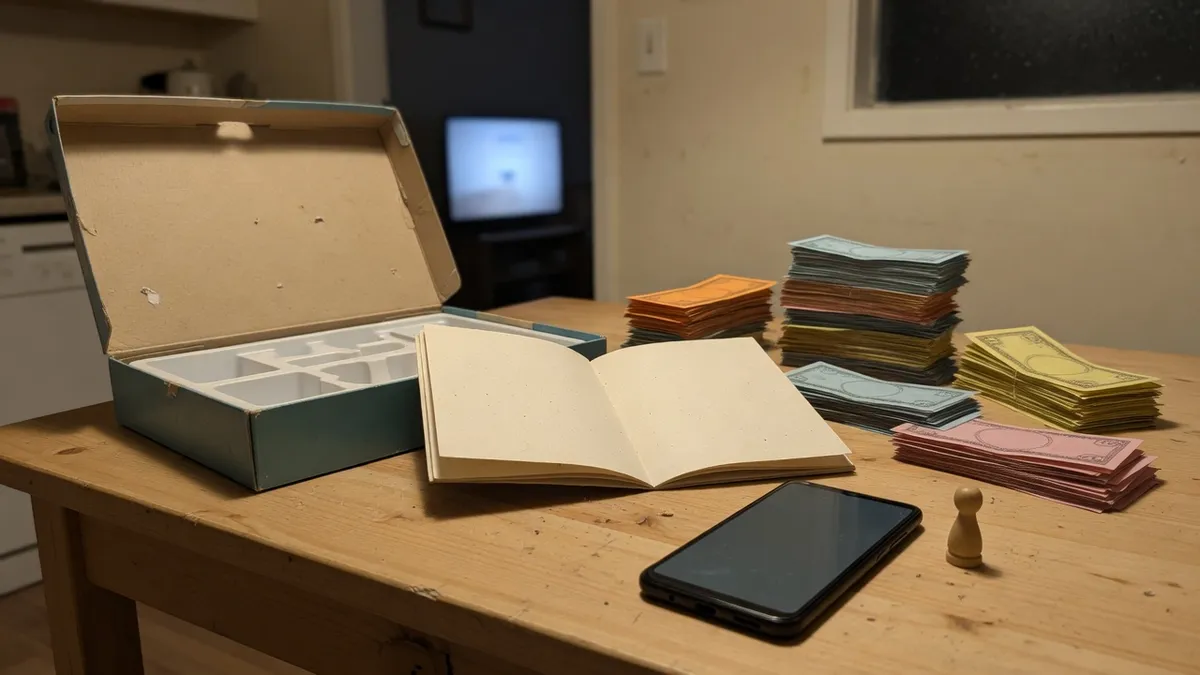
The lid is off and the rulebook is open to page one. You are four minutes into reading the setup out loud. The seven year old is stacking the paper money into towers, the fifteen year old's phone is face up next to a piece that has not moved, and your partner is finishing the dishes and will sit down when it starts. In the next room the television is still on.
Most family game night ideas are lists of games. The game is rarely what goes wrong, though. What goes wrong is everything before the first turn, and a game that suits a seven year old bores a fifteen year old, or the other way round.
What happens before the first turn
First there is a vote on what to play. The box comes down, somebody reads the rules aloud, the pieces get sorted, and then the seven year old works out how the game goes and wants to change the rules. That can take twenty minutes before anyone rolls a die, and it is usually what your family is objecting to when they drift off, even though it sounds like they are objecting to the game.
The television, meanwhile, needs no vote and has no losers. The Bureau of Labor Statistics found that in 2025 Americans spent 2.61 hours a day watching TV, about half of all their leisure time, so on most evenings that is what game night is up against. The way to compete is to make getting started just as easy.
Three questions for any game
Can the youngest win without being the cleverest player at the table? A seven year old will not plan as far ahead as a fifteen year old, and does not need to when speed, luck or a team decides the outcome.
Is one game over in about fifteen minutes? A short game lets the fifteen year old leave between rounds while everyone still has a winner, and it lets you play again straight away if it goes well.
Can someone explain the rules in a minute? A game that needs pages of rules read aloud has used up everyone's patience before the first turn.
Family game night ideas that pass all three
Spot It. Every pair of round cards shares exactly one picture, and the first player to spot it and call it out wins the card. Young kids are often faster at it than adults, and a round takes a few minutes.
Sushi Go. Players pick one card from their hand and pass the rest along, trying to collect sets of sushi. It plays in about fifteen minutes, reading is minimal, and a seven year old picks it up in one round.
Exploding Kittens. Players draw from a deck with exploding kitten cards hidden in it and use the rest of their hand to dodge them, and there is enough luck that anyone can win. The cards are full of silly drawings and jokes, which helps keep a fifteen year old at the table.
Just One. Everyone works together: one player guesses a secret word from one word clues written by the others, and any duplicate clues are cancelled. Nobody loses to anybody, which suits a house where siblings fight.
Telestrations. A drawing version of the telephone game where each sketch gets passed on and guessed. It is funniest when the drawing is bad, so skill barely matters, and there is no need to keep score.
Charades. It needs no box at all, and the youngest can play on a team with an adult.
Uno and Jenga. Both are classics that still pass: a hand of Uno or a tower of Jenga takes about ten minutes, and luck or a careful hand counts for more than strategy.
| Game | Youngest can win | One game takes | Rules to explain |
|---|---|---|---|
| Spot It | yes, often | a few minutes | one sentence |
| Sushi Go | yes | about 15 minutes | one minute |
| Exploding Kittens | yes | about 15 minutes | one minute |
| Just One | everyone wins or loses together | about 20 minutes | one minute |
| Telestrations | no score needed | about 30 minutes | one minute |
| Charades | yes, on a team | a few minutes a round | none |
| Uno | yes | about 10 minutes a hand | one minute, plus your house rules |
| Jenga | yes | about 10 minutes | one sentence |
| Monopoly | rarely | hours | several pages |
| Scrabble | rarely | an hour or more | one minute |
The game night games that end in arguments
Monopoly ends when somebody goes bankrupt, so the player who fell behind at 7:30 spends the rest of the evening watching everyone else finish. The trading also favors whoever is older and better at bargaining. Risk works the same way and takes longer.
Scrabble rewards a bigger vocabulary, and the tiles you draw rarely make up the difference, so a seven year old playing a fifteen year old knows within a few turns that they cannot win.
Sorry and Trouble are mostly luck, but they let the player whose turn it is choose which opponent to send back to the start, which gives an older sibling a way to pick on a younger one every turn.
Uno causes a different argument, about the rules. Families play different versions of stacking draw cards and of when a Draw Four can be played. Write your family's rules inside the lid before you deal.
Pick the game before anyone sits down
One person picks the game each week, and the job rotates. Whoever is picking says the name of the game and the time it will end out loud, before the box comes off the shelf, and nobody votes. If the game is new, the person who picked it reads the rules beforehand and explains them in a few sentences at the table.
Hand next week's pick to the fifteen year old and play what they choose, even if it is a game you have never heard of.
Expect some pushback in the second week, once the novelty has worn off. It usually shows up as people saying maybe later or picking up their phones rather than as an argument. Keep the day and the end time the same, keep the games short, and stop while people still want one more round.
This article is for informational purposes only and does not constitute medical, financial, or professional advice.